Power meters like SRM, Ergomo and Powertap are very useful if you want to optimize your training and start getting better results. Before you throw away all your pocket money consider how serious you are with your training. If you find it very difficult to stick to a rigid training scheme, doing specific intervals in heart rate target zones, then a power meter might not be the best choice for you. If you think that analyzing your performances or registrating your training sessions is a waste of time, then you are probably not ready for cycling with a power meter yet. But if you get excited when you turn on your computer immediately after parking your bike, watching your heart rate file, then you will likely be even more excited about the data from a power meter. If you like to make training plans or have a cycling coach who works out plans for you, then a power meter will be a very powerful tool, which gives you opportunity to make better training plans.
Power meter training starts a new era
Like the heart rate monitors started a new era back in the 80´s, and got mainstream in the mid 90´s, the power meters started a new one in the early 90´s and are now getting popular among amateur riders here in 2006. The SRM crank system was the one and only power meter system in the beginning, but now there are a couple of other systems on the market. Powertap and Ergomo uses different technologies than SRM´s crank system, but they give a precise measurement of watts. SRM is the most expensive system, while Powertap and Ergomo is less expensive. I will not make further comments on the differences between SRM, Powertap and Ergomo, but instead save my words for a review later. What you need to know is, that there are different technologies and different prices. Generally they all allow the workload to be measured correctly.
In the first couple of weeks I will recommend that you just continue to train as normal. It will be a very good education for you to spent this time studying how quickly the power meter react to your effort. People get surprised when they accelerate the bike for the first time and discover that they are pushing more than 500W (for a short while, naturally”¦)
After a few weeks you will be getting more familar with your new equipment. You are now ready to make your first observations with this powerful tool. Before you can start doing intervals or pacing with your power meter, you have to make a test of your physical performance. To make things easy and time saving, I recommend you do a 5 minutes allout test to measure your wattmax. You can use the software that followed your power meter or you can a software system like Cyclingpeaks which offers more opportunities. After your 5 minutes allout test you have to figure out what your average power output was. Also notice your body weight since this is an important factor when comparing test results. You are now able to make your first training program based on test results from your power output.
Make maximum power tests to define your intervals
It is possible to convert your test result to shorter or longer intervals. There will be less accuracy depending on what kind of rider you are. Some people can keep a high percentage of their VO2 max for a very long period of time, and other people who are much better at shorter distances where they can perform impressing high average watts for short intervals. Therefore this table is only a guideline and the best way to define your target zones is to do a test at that specific distance. If you are a track rider and are training for 1km time trials (anaerobic endurance and strength) you will have to test your power output at that distance.
| |
Power output |
Training examples |
| Sprinting |
200-?? % |
5×150m (complete rest) |
| Anaerobic endurance |
100-130% |
5x(1+6min) |
| VO2 max |
90-105% |
3x(3+2min) |
| Threshold |
85- 90% |
3x(8+4min) |
| Endurance |
50-85% |
3 hours |
| Recovery |
40-50% |
1 hour |
Next time you go to a race, use your power meter to collect data from the race. You will see, that you spend time in all the target zones in the table. Have a look at the interesting parts of the race. This investigation is an important part of having a power meter, and it is here you can discover things you would never have found out. You can see the difference it makes in crosswinds to sit behind a bunch of riders compared to suffering in a long line. When you see that big difference, you will definitely try even harder to keep your good position in the bunch in the crosswinds next time.
Time trialists uses watts for pacing
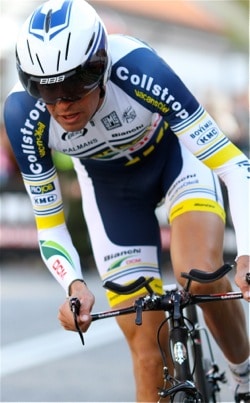
Time trialists love to train with power meters because they can see exactly how good they perform and make it easier for them to see progress. With a little training it is possible to use the power meter as a pacer during the time trial. In this situation they can compare their physical performance from time trial to time trial. These data files are not affected by the wind, course or equipment, so they are very useful to see how the form changes.
If you have a velodrome in your neighborhood you can make tests to improve your position on your bike. Serious time trialists should consider this and at least give it a try. Testing in a wind tunnel is very expensive, so testing on a velodrome with your power meter might be a cheap alternative. When you do the tests you will need at least one assistant to take split times for each lap. With a little training in this setup, you can try different positions and equipment, and see which combination saves most watts. This part of using a power meter is the more challenging part, but I promise, that it is very satisfying when you save a couple of watts.