
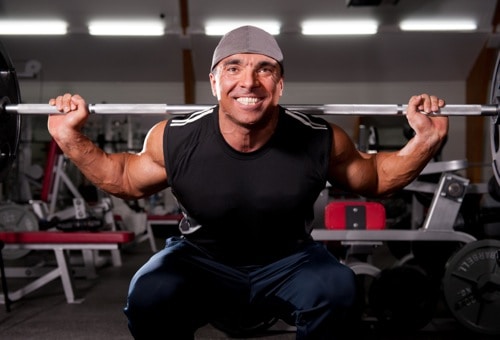
If you have decided to enter the gym this winter, implementing squats into your training program is challenging to avoid. However, this exercise is the best way to increase your leg strength in a very practical way. If you only have time for one activity, perform some good squats.
I tested a strength training program with squats as the primary (or sometimes only) exercise. It was time effective, and the rider reached similar strength levels as previous years when he had done several other activities.
Therefore, I recommend that squatting should always be the bread and butter exercise in a cyclist’s strength training program. That is why you might have heard squats mentioned as “the king of exercises.”
However, strength training is not that time effective and is not recommended if you want to be ultra time effective.
Actually, it is counter-productive to speed up to high-quality strength training sessions because the recovery periods are essential when you build neuro-muscular power.
Heavy Weights Matter
First of all, you have to reconsider how to make your muscles stronger. The short answer is that you have to lift heavy weights frequently. If the weights aren’t heavy enough, they will not force the muscles to make neural adaptations or hypertrophy.
The good thing about squats is that it is possible to work with heavyweights, which puts enormous stress on legs, calves, hamstrings, glutes, and abdominal and back muscles. But, as you can see, most of your body is working in coordination to lift the weight.
Can you imagine what this exercise will do to your overall strength?
You will get a significant boost not only for your leg extensors (quadriceps) but also several other essential muscles at the same time.
Functionality
Non-functional exercises are challenging to convert to something useful in your cycling. This is because strength training is teaching for your nervous system.
Here is an example: If you compare an elite tennis player with a pro golfer: who will win the match if these elite sportspeople play badminton? That would probably be the tennis player because tennis is a racket sport similar to badminton.
So the tennis player gets an advantage because his nervous system is optimized for movements that are similar to those in badminton. Therefore, it is easier for him to convert his tennis skills to badminton than for the golfer to start playing a racket sport.
Squatting is a lifting style closely related to pedaling and therefore gives you the best opportunity to convert strength gains made in the weight lifting gym to better cycling performance.
On the other hand, commonly used exercises such as leg extensions (or even worse, leg adductions or abductions) are single-joint movements that are very difficult to convert into cycling power. Therefore, leg extensions should be used only by cyclists with injuries and otherwise left for people who don’t know squats’ power.
Would it not be more beneficial to simply pushing a large gear (if on a trainer) or doing steep hills. I personally have gotten more out of doing 28% grade repeats for 2 hours then doing any sort of lifting…
Andrew Coggan / Ric Stern seem to think weight training is useless / detrmintal compared to cycle strength training specificity.
Hi David,
Thanks for commenting, it is definitely an interesting question.
Strength training for cyclists is a controversial topic which I have tried to describe in https://www.training4cyclists.com/strength-training-might-increase-performance/
Qoute:
“Strength training is a controversial topic when we discuss optimizing of training programs for cyclists. There is no definitive answer to whether cyclists should include weight lifting in their winter training plans. There have been made several studies which have not yet proved that cyclists can benefit from strength training.
One of the biggest problems for these scientific studies is that they are done at untrained people and the study group is usually small. That makes it rather difficult to prove a significant difference between endurance training only versus endurance training combined with weight lifting. My best guess is that strength training does make a difference and it is, at least in theory, possible to prove it with a larger study group. But the difference between including strength training or not, is obviously not the most important factor when it comes to overall performance in road races. Thus, it is very difficult to recommend you to either go to the gym or spend an extra hour on the bike. In both cases you will probably improve your overall performance level. It is important to notice that even though studies about strength training does not produce significant gains in overall cycling performance, it is very likely that there is a difference. ”
This article about squat is primary an article to show why you should squat IF you decide to strength train. Not to discuss whether you should strength train.
2 hours of 28% grade repeats does not sound as max strength training to me, rather like strength endurance, which I always recommend should be done on a bike. That is why I don’t recommend long strength endurance sets with 12, 20 or even 100´s of reps. That is better done on the bike.
But when we are talking max strength, squat gets important, because you activate almost every single motor neuron in your quadriceps (and a lot of helper-muscles) in a heavy lift. It is very difficult to activate the same percentage of motor neurons on a bike, and especially if you are doing steep hills that take more than 5 revolutions in the pedals. When you train for neural adaptations it is important to activate as many motor neurons as possible. Also, there is some discussion whether a better neural control will help you to be more efficient when recruiting muscle fibres.
Hi Jesper,
First of all, your blog rocks and I read it regularly. Thanks for all the great tips; I’ve found your indoor training interval tips very useful.
In regards to squats, I’ve read in a few places that it is beneficial to hop on the bike after a squat session to do 30-60 minutes of spinning. Presumably this is to “train” your now stressed and healing muscles to adapt the learned forces from the squat directly to the bike.
Does this make any sense to you, and can you clarify what actually may be happening here, if anything? Thank you again!
Hi Erik,
Glad you like this blog. I will do my best to keep posting articles worth reading.
I have heard the advice you mentioned before, but I haven’t seen any documentation for this theory. I think it is difficult to explain how and why it might work. Nevertheless, I recommend my riders to do the warmup on the bike and take a ride after strength training.
Best regards,
Jesper
Interesting… thanks for the reply, Jesper.
Squats are the “Queen” of exercises. Deadlifts are the “King” in regards to muscles worked in one exercise, tranferable strength to real life and not nearly a technical, or dangerous. I am not a cyclist but I am a strength coach. I have encouraged my brother in law who is a competitive mountain biker to use deadlifts, push presses and chins to get a complete body workout. What I have suggested to him is to follow Mark Verstegan’s mobility recommendations for pre-workout preperation and follow a Pavel T/Barry Ross type workout for the resistance portion (check Barry’s Sprinter workout on Dragondoor.com) along with conscience effort to use proper recuperative techniques. Assuredly you will get superior hamstring group involvement in the dead and depending on the range of motion, good quad involvment, as well, especially with something like the snatch grip dead off blocks. For the older cyclists, if pain is the issue on back squats or deads, have a look a front squats down to a box or stepups. Remember, you are using this portion of your training economics to build strength. Keep the reps low, build strength and it will convert to usable quality in your riding. Just 2 cents from the strength enhancment side of things.
Hi,
I do squats twice a week, 2 sets of 25 reps 92% of my body weight as the weight used. I also do deadlifts but with very light weights, likewise at 25 reps per set.
My climbing has improved a lot and so has my average speed. I have to improve though on my sprints and attacks as I normally run out of gas towards the end.
Your tips are very helpful but I guess to further improve my riding I need more saddle time.
Tony, I would recommend doing 4 sets of 10-15 reps for strength gains which would improve your sprinting time significantly as it would focus on strengthenning your fast twitch muscle fibres.
Tony and Tim>>
I don´t recommend sets with more than 8 reps if you want to develop strength. If strength is the primary goal you should concentrate on doing sets in the rep range 3-6.
Read more here:
https://www.training4cyclists.com/5-mistakes-in-the-weight-lifting-gym/
Best regards,
Jesper
Pingback: 5 mistakes in the weight lifting gym | Training4cyclists.com
Pingback: Strength Training On The Bike?
Jesper, your site is fabulous, thanks for putting so much effort into it. I’m guessing but you probably have alot of silent followers using your advice.
I was an endurance cyclist for about 8 years, ultra distance stuff but not very fast. I took up racing a couple of years ago and have mofied my training to include more intensity but I’m still getting dropped in the short sprints or short hills. If the hill is long enough I can slowly roll the group back up. I suspect a lack of power as I’m at 100% HR and my lungs are on the edge of exploding. I have a lower back problem and adding weight to my spine doesn’t go so well for me. Have you any suggestion on how to develop more power without crushing my spine?
Hello Jesper. I don’t ride much, but I’ve been squatting for four months and am to up 190 lbs for 3 sets of 5, with a personal record 200 for 2 reps.
I got on my bike a few days ago after more than a year off, and I noticed I had more power than ever. I was climbing formerly challenging hills without problem, without standing up.
The initial gains in a solid strength training program are dramatic, and it’s hard to argue against squatting if you want to improve your riding.
Hi Jesper!
What kind of squat is it you recommend, one leg, two leg, deep, front?
Best regards
Fredrik, Sweden.
I added squats and deadlifts to my winter training program and my hill climbling and sprints improved significantly. I performed 4 sets of squats on Monday and 4 sets of deadlifts on Thursdays along with some upper body exercise and core training on both days. I now squat over 225LBS.
I learn something new everyday and I definitely learned it again from this article. I”m still wondering about the leg press and how much the squat is dissimilar.