
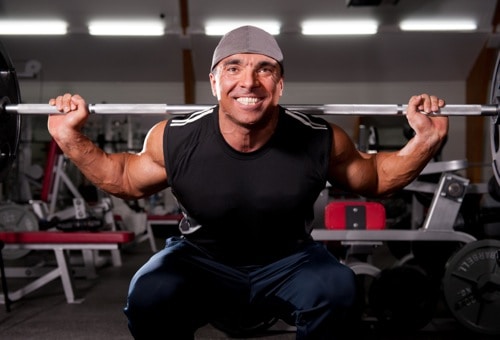
I have covered this topic a couple of times before, but there are still many reasons to consider whether weight training is a waste of time or a way to improve your overall performance. When road cyclists discuss strength training, it sounds like a discussion of religion rather than about having some amusement in the wintertime.
There are firm believers in the possible gains from strength training, and strong opponents argue against lifting weights.
There are very few arguments supported by scientific research.
Like most studies in exercise physiology, research on trained cyclists is always made on small groups, thus making it very difficult to prove significant differences for trained individuals.
Effects of weight training for cyclists remain unknown
After we have entered the Power Meter era, it is evident for most riders that there are heavy bursts with workloads above 1000Watts in bike races.
Can strength training improve these heavy bursts?
Well, that question is still unanswered. This question is not yet answered because we lack data to support the theories bike coaches and cyclists have about strength training. The question is whether it is possible to convert the neuronal power from strength training to extra power on the bike.
One of the more serious ideas is that strength training makes muscles more efficient when recruiting muscle fibers for a contraction. This theory makes sense to me, but it is tough to prove that in the lab.
Ric Stern, a British cycling coach and busy writer in a couple of bike forums, is pretty convinced that it is not possible to benefit from strength training if you are a well-trained cyclist. I’m afraid I have to disagree with him for two reasons:
1. Statistical power is insufficient to say that strength training will not help riders. For example, let’s say there is a benefit of 1 single percent of strength training (and it is probably less). However, scientists will never find that difference in a study with 15 riders randomized into two groups.
You will probably need study groups with more than 1000 riders to prove minor differences. To illustrate the problem: The opposite scenario. How many studies have shown that trained cyclists get significantly worse when strength training? It is clear that this answer will probably not be answered by statistics since there will not be any studies or meta-analyses strong enough to prove that minimal difference strength training might do.
2. Most riders train on programs focused on hypertrophy. These programs are not worth considering for neural adaptations. In addition, most riders train very differently from my recommendations for strength training without additional body mass.
Riders have considerable potential to adapt some of the training principles athletes use in weight-limited sports (e.g. track & field).
It is well known that these athletes benefit from strength training, but there has also been more studying of practical training in athletics. In road cycling, there is much more money in developing aerodynamic equipment; thus, that is where all the brains go. One of the biggest problems in road cycling is recruiting educated cycling coaches.
Think of how many cycling coaches are old pros?
Not surprising that road cycling is way behind the scientific training strategies that many other benefits from.
Weight lifting requires a special mentality
There are several other explanations why some riders prefer to strength train and others don’t.
If you hate the game, you will rarely become the star in that particular game.
Some riders have a talent for strength training, which differs from endurance event road cycling. In road cycling, it is much about working hard for hours and suffering. Not much time or energy is left for jokes or small talks. There is a whole different atmosphere in weight training that often doesn’t fit an average endurance rider.
Strength training for neural adaptations requires a long recovery between each set, which I know very few riders respect.
Instead, they try to translate their attitude from the roads into the gym like “No pain, no gain” and experiments with workouts they can do in the recovery periods.
Weight Training for Cyclists – Motivation is important
Before entering a strength training program, please consider if you are willing to follow the necessary principles to reach your goals.
If you don’t want to develop neuronal strength, you will probably become a better cyclist if you stick to training on the roads.
If you are motivated for strength training in the wintertime and follow the instructions, there is a fair chance that you get better, and it is doubtful that you will get weaker.
Conclusion
It is impossible to prove the significant effects of strength training because the available studies lack statistical power. There are too few observations to prove the good or bad influence strength training has on cycling performance.
So there are no guarantees that strength training will make you a better cyclist, but it might make you a happier and more motivated cyclist during the dark wintertime.
Weight training helps in the winter, like you wrote. Plus it helps to balance out the funky shape road cyclists tend to get, where we’re all muscle in the thighs with nothing else anywhere else.
I am a female (and due to not naturally having that much upper body strength)I found that weight training benifited me a lot when it came to cycling!
Arms, neck and back can cope with the stress of longer rides no problem now, and recovery time has definatly improved for me.
As you mentioned, a lot of time and money is spent researching aerodynamics, cycle geometry, etc etc. Some of this research showed a couple of interesting things to me that in a round-abouts way support a trained upper body, a good example is the differences in bars between triathlon/tt bikes and standard road/race bikes. Aero bars on triathlon bikes support some upper body weight through the elbows meaning less energy is expended, it would make sense that specific kinds of upper body weight training to make weight-supporting upper body muscles more efficient would pay a small dividend in a race…as previously mentioned it logically couldn’t be more than a percent, or a fraction of a percent, but everything counts right?
It seems studies have shown almost no difference in LT, VO2 or just power for longer times, when groupes with or without strength training are compared. But the amount of time spended by both types of groupes are usally the same. That means the strength groupe has replaced an amount of endurance- for strength training (mostly variating. from 20 to 50%).
I conclude that eventhough the results are the same, the time spent on the bike is differend. It may not have a direct physical effect, but mentaly, training in a different envoirment, may have a bigger effect. Doing long miles day in day out can be very boring. Training inside on a different setting may give you a mental boost.
My second conclusion is that most study´s don´t show direct increase in VO2, LT or power over longer time, the direct power over a short period of time, wich in many studies hasen´t been tested, does increase. That means you get directly more power to make a brakeaway or go up a hort (steap) hill much faster.
So to end, I believe strength training does work, especially in the (not so specific) preperation time. Going to the gym 2 or 3 times a week combined with low intens endurance training is an excellent way to make a good fundation for next season. In the specific preperation or competion time strength training should be reduced to make way for specific (more intens) cycling training. Strength training in these periods should only be done to preserve the core of the body, and maybe ones a week for the legs, but not to intens though.
JvW cycling sience (coach for some elite cyclist)
Holland
JvW -> I like your comment about training in another enviroment. That is one of the main reasons I stick to strength training programs even though the scientific evidence is not impressive.
Pingback: Strength Training Without Additional Body Mass - 1
I was looking to incorporate the winter weight program with the 12 week winter training program how do you handle the lifting weights on M and Th, but also doing intervals on Th?
I tend to agree with benefits of strength training for cyclists. And if you look at another endurance sport like cross country skiing you will find example of elite marathon skiers doing very similar training to what I see in your 12 week program.
My question for you is around plyometrics and complex training where you do weights, followed by plyometrics followed by on-bike sprints (maybe more practical to do on spinning bike in gym or on trainer). I think as an athlete gets closer to racing season moving from heavy weights to plyometrics help closer mimic the speed of contraction of racing.
What are you general thoughts on plyometrics, and how do you think they might be incorporated into training program? What about complex exercises such as described above?
Weight training is not just about the “Power to the Pedals” Its also about the lean body mass that comes along with Weight training. As we prepare for the up coming race season, racers should focus on maintaining a lean body. While some may develop larger muscles then others and the weight of a rider may increase, the body fat of the rider will decrease. The calorie requirement to keep the developing muscles will increase thus assisting in calorie counting. If the weight training is stopped or significantly decreased lets say 6 weeks prior to racing the muscles will atrophy and reduce in size and mass. Also note: there would be no additional factor to incorporate to lose the weight, just stop training with weights. (I like that).
Hi guys,
Help is needed
I’ve just sign up for a London to Paris cycle ride where I be cycling 300,miles in three days ,I am looking for a training programme to follow for strength training to long rides,what advice or program is out there for me to follow
The biggest advantage for cyclists to weight train is to correct the power robbing muscle imbalances created by cycling. The seated position also shuts the glutes down further tightening hip flexors.
Then there is the need for posterior chain work to open up the fro t half of the body after cycling closes it down. This is why crunches should be something every cyclist leaves off of their lost of to do’s in the gym. Planks too for that matter.
Single leg work is the best way to go for cyclists, far superior than seated press, curl or knee extensions.
As far as I know, cycling requires that you have strong core muscles – this group of muscles are not developed on the bike, but in the gym.
Cycling does require having a strong core. Also it is important to strengthen hip abductors and other parts of the leg to prevent injury. My first season of hardcore mountain bike racing I ended up with an nagging IT band injury that did not go away for three years. I finally had surgery and I have had no problems with it since. I now believe it is incredibly important to strength train before the season to help prevent injury.
Human performance is complex and as such cause and effect from different training methods takes good methodology to “proof” the efect.
However most sports (track, field, scorer, football, basketball, boxing, high jumping, volleyballswimming etc.) at the elite levels have very time consuming weight training embedded in their training backed up by hard evidence of the improvements. Why would cycling be such so different? Track has established that sprinting is a power event and power comes from weight training. Cycling coachs are just closed minded.
I found running a heavy powerlifting routine year round has boosted all 3 sports for me in triathlon I squat 290kg, bench press 180kg & deadlift 310kg and can now do a sub 11 hour ironman compared to my almost 13hrs before. People think lifting heavy will make you bulky but not true you need to eat and rest to grow big and when working in the 1 to 5 rep range it’s purely strength my advice to antone give it ago